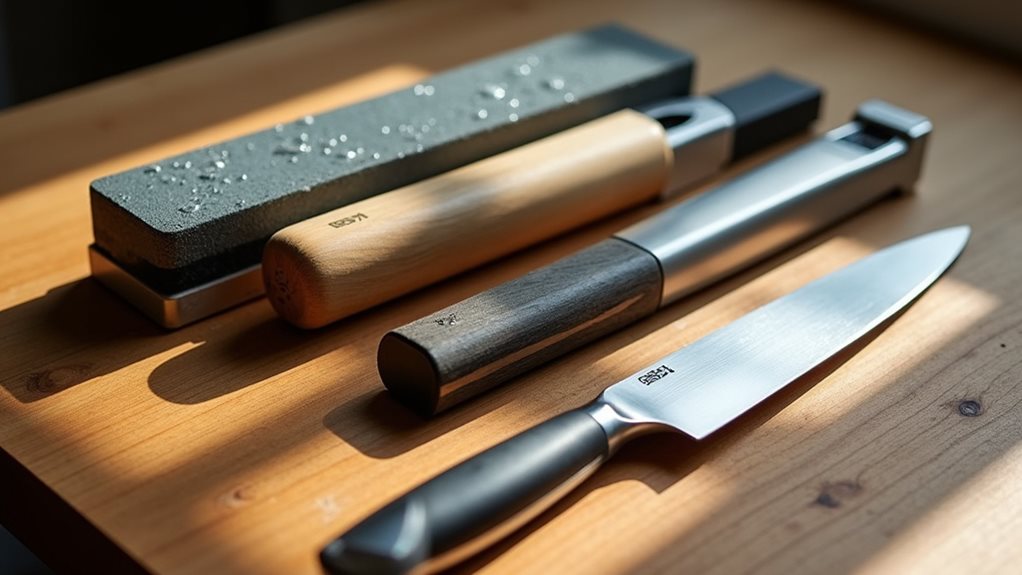
Your Japanese knives deserve proper care to maintain their legendary sharpness and precision. Whether you’re a professional chef or home cooking enthusiast, having the right sharpener makes all the difference between struggling with dull blades and enjoying effortless cutting performance. A quality Japanese knife sharpener won’t just restore your blade’s edge—it’ll extend your knife’s lifespan and improve your overall kitchen experience. Let’s explore the top three options that balance tradition, innovation, and effectiveness.
MITSUMOTO SAKARI Japanese Adjustable 5-Angle Knife Sharpener


Whether you’re a professional chef or home cooking enthusiast, the MITSUMOTO SAKARI Japanese Adjustable 5-Angle Knife Sharpener stands out as a versatile solution for maintaining razor-sharp blades. Its precision guide rail technology with angle-locking guarantees error-free sharpening every time you use it.
You’ll appreciate the three-stage sharpening process: coarse diamond grinding repairs damaged blades, fine ceramic wheels adjust the edge, and steel polishing creates a lasting finish. The anti-slip ergonomic handle makes sharpening safe and comfortable. This multifunctional tool works on everything from kitchen knives to scissors—simply slide your blade through the appropriate groove, and you’ll restore sharpness without needing special skills.
Best For: Professional chefs and home cooking enthusiasts who want a versatile, precise knife sharpener that can handle multiple types of blades and sharpening needs without requiring technical expertise.
Pros:
- Features a 3-stage sharpening process with diamond, ceramic, and steel wheels to repair damaged blades and create long-lasting sharp edges
- Adjustable 5-angle design with precision guide rail and angle locking technology ensures consistent, error-free results
- Versatile enough to sharpen various tools including kitchen knives, professional chef’s knives, peelers, and scissors
Cons:
- May require some practice to master the different angles and sharpening stages
- No specific information provided about maintenance requirements for the sharpening wheels
- Might be more complex than needed for casual users who only occasionally sharpen knives
Sharp Pebble Premium Whetstone Knife Sharpening Stone (1000/6000 Grit)
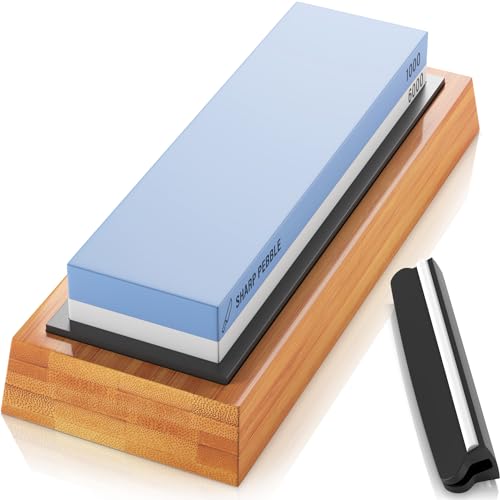
The Sharp Pebble Premium Whetstone offers professional-grade sharpening capabilities for serious home chefs and culinary enthusiasts who demand precision-sharp edges on their Japanese knives. Its dual-sided design features 1000 grit for reshaping dull edges and 6000 grit for polishing to razor sharpness.
You’ll appreciate the thoughtful accessories: a sturdy bamboo base with non-slip rubber for stability, an angle guide to maintain proper sharpening technique, and detailed instructions. Made from high-quality Aluminum Oxide, this water-based system eliminates the need for messy oils. Whether you’re maintaining kitchen knives, hunting blades, scissors, or even straight razors, this versatile sharpening system delivers consistent results with minimal effort.
Best For: Home chefs and knife enthusiasts seeking a professional-grade sharpening solution for various blade types who value precision and are willing to learn proper sharpening technique.
Pros:
- Versatile dual-sided design with 1000/6000 grit options allows for both reshaping dull blades and achieving a polished, razor-sharp finish
- Complete kit includes helpful accessories like the bamboo base, angle guide, and instructional materials to assist beginners and ensure proper technique
- Water-based system eliminates the need for messy oils and works on a wide range of blades from kitchen knives to straight razors
Cons:
- Requires learning proper technique and practice to achieve optimal results, which may intimidate beginners
- Water-based sharpening can be messy until you develop experience with managing the process
- More time-consuming than pull-through sharpeners, requiring patience and attention to detail for best results
3 Sharpener Black/Red

Busy home chefs who’ve struggled with maintaining razor-sharp edges on their favorite Japanese knives will find the 3 Sharpener Black/Red an absolute game-changer. This hand-held sharpener requires no electricity or batteries, making it convenient for quick touch-ups whenever needed.
What makes this tool exceptional is its three color-coded ceramic wheels—rough, medium, and super-fine—that progressively restore your dull blades to their original sharpness. Though designed specifically for Global knives, you’ll find it works effectively with most brands. The built-in water reservoir and innovative ceramic construction guarantee your knives are sharpened at precisely the correct angle, even if you’re a complete novice to knife maintenance.
Best For: Home chefs who want a simple, effective knife sharpener that requires no special skills or electricity to maintain their Japanese knives and other kitchen blades.
Pros:
- Features three color-coded ceramic wheels (rough, medium, and super-fine) for progressive sharpening that restores dull knives to their original sharpness
- Includes a water reservoir and innovative ceramic construction that ensures blades are sharpened at the correct angle without any expertise required
- Portable, hand-held design requires no batteries or electricity, making it convenient for quick touch-ups anywhere in the kitchen
Cons:
- While designed specifically for Global knives, it may not provide optimal results for all knife brands or specialty blade types
- Hand-powered operation may require more time and effort compared to electric sharpeners
- Limited to manual sharpening capability without the precision control that might be found in professional sharpening systems
Factors to Consider When Choosing Japanese Knife Sharpeners
Selecting the right Japanese knife sharpener requires careful consideration of several key factors that will impact your sharpening results and overall experience. You’ll need to evaluate sharpening angle options that match your specific knives, the quality of materials used in the sharpener’s construction, your personal skill level, and the maintenance requirements of different sharpening systems. Understanding these vital elements will help you make an informed decision that aligns with your needs and guarantees your valuable Japanese knives remain precisely honed for years to come.
Factors to Consider When Choosing Japanese Knife Sharpeners
When investing in Japanese knives, choosing the right sharpener becomes equally important as selecting the knife itself. Your sharpener’s mechanism plays a vital role in maintaining blade quality—traditional whetstones offer precision, while handheld sharpeners provide convenience for quick touch-ups.
Look for sharpeners with adjustable angle features that match your knife’s specific blade geometry. The materials matter greatly; high-quality components like diamond, ceramic, or aluminum oxide will guarantee effective sharpening and lasting durability. Multi-stage sharpening processes are ideal, allowing you to progress from coarse grinding to fine polishing for thorough blade maintenance.
Don’t overlook safety features—non-slip bases and ergonomic designs prevent accidents during sharpening sessions. By carefully evaluating these factors, you’ll select a sharpener that preserves your Japanese knives’ exceptional cutting performance for years to come.
Sharpening Angle Options
The perfect angle makes all the difference in Japanese knife sharpening, serving as the foundation for both cutting performance and blade longevity. When selecting a sharpener, you’ll want to look for adjustable angle options that accommodate various knife types.
Most Japanese sharpeners offer angles between 15 and 20 degrees. For precision tasks requiring exceptional sharpness, choose a 15-degree setting. If you’re working with heavier cutting jobs, opt for the 20-degree angle to improve durability. The ability to lock in your chosen angle guarantees consistency throughout the sharpening process, minimizing errors that could damage your blade.
Many premium sharpeners feature multiple angle settings, allowing you to maintain everything from delicate sushi knives to robust chef’s knives with a single tool. This versatility maximizes your investment while refining each knife’s performance.
Material Quality
Superior materials form the backbone of any effective Japanese knife sharpener, determining both its performance and longevity. When evaluating options, you’ll want to prioritize sharpeners featuring diamond, ceramic, or aluminum oxide components, as these materials deliver exceptional sharpening capabilities while standing up to regular use.
High-quality materials don’t just last longer—they’re gentler on your precious Japanese knives. Premium sharpeners maintain their effectiveness over time, guaranteeing your blades receive consistent, precise treatment with each sharpening session. You’ll notice the difference in how seamlessly the blade glides across a well-constructed sharpener, reducing the risk of accidents or uneven edges. Remember, investing in a sharpener made with superior materials ultimately protects your knives, preserving their edge integrity and extending their useful life considerably.
Skill Level Required
Choosing the right Japanese knife sharpener depends greatly on your existing sharpening experience and willingness to develop new skills. Beginners should look for sharpeners with guided angles and user-friendly mechanisms that deliver sharp results without technical expertise. These guided systems help maintain proper angles, guaranteeing you don’t damage your valuable Japanese knives while learning.
Intermediate users who understand basic sharpening principles might prefer adjustable systems that offer more control while still providing some guidance. If you’re willing to invest time in mastering the craft, advanced options like traditional whetstones offer superior results but require considerable practice to perfect the angle, pressure, and technique. Remember that while more complex sharpening systems often yield better results, they’ll demand more patience and dedication to master properly—a worthwhile investment for serious Japanese knife enthusiasts.
Maintenance Needs
When selecting a Japanese knife sharpener, maintenance requirements should factor prominently into your decision-making process. While Japanese sharpeners typically require less frequent maintenance than their counterparts, they still need proper care to function at peak performance.
For whetstones, you’ll need to soak them before use and clean the surface after sharpening to remove metal particles that accumulate during the process. Regular inspection of your sharpener’s alignment guarantees it maintains the correct angle for your blades. Don’t overlook the importance of cleaning the base and handles, as these components affect stability and comfort during use. A well-maintained sharpener not only operates better but also lasts longer, making your investment worthwhile. By understanding these maintenance needs beforehand, you can choose a sharpener that fits your willingness to perform regular upkeep.
Versatility Across Blades
Beyond proper maintenance, the adaptability of your Japanese knife sharpener to various blade types can make or break your sharpening experience. The most versatile models accommodate everything from delicate yanagiba sushi knives to robust deba cleavers, guaranteeing you don’t need multiple sharpening systems in your kitchen.
When evaluating options, prioritize sharpeners with multiple stages or grit levels, which allow you to progress from repair work to refined polishing on the same device. The ability to maintain correct angles—typically between 15-17 degrees for Japanese blades—is crucial for preserving your knife’s integrity and performance. Look for features like adjustable angle guides or preset angles designed specifically for Japanese steel.
Non-slip bases and ergonomic grips aren’t mere conveniences; they’re safety features that enable precise control across different blade sizes and shapes.
Stability During Use
Three critical factors determine the stability of your Japanese knife sharpener, with each playing a vital role in achieving precise, consistent results. First, the base construction must incorporate anti-slip materials like rubber that grip your countertop firmly during operation. You’ll notice quality sharpeners feature wider, heavier bases that resist shifting when you apply pressure to the blade.
Second, consider the overall weight distribution of your sharpener—heavier models naturally resist movement, allowing you to maintain consistent angles throughout the sharpening process. Finally, look for designs that incorporate water reservoirs, as these serve a dual purpose: they provide necessary lubrication for the sharpening stones while adding mass that improves stability. When these elements work together, you’ll achieve the controlled, steady sharpening motion that’s crucial for maintaining your Japanese knives’ exceptional edges.
Storage Requirements
Selecting the perfect Japanese knife sharpener requires careful consideration of your available storage space, as even the most effective tool becomes burdensome if it can’t be conveniently stored. Compact or foldable models work best if your kitchen space is limited, while larger multi-stage systems need dedicated drawer or cabinet space.
Always store your sharpener in a dry environment, away from humidity that could damage its components or affect its performance over time. Many quality sharpeners include storage solutions like protective cases or bases, which help keep them organized when not in use.
If you’re investing in a whetstone system or a sharpener with multiple components, make certain you have adequate space for all accessories, including angle guides and cleaning materials that accompany your primary sharpening tool.
Frequently Asked Questions
How Often Should I Sharpen My Japanese Knives?
You’ll need to sharpen your Japanese knives every 3-4 months with regular home use. However, if you’re using them professionally, sharpen them every 1-2 weeks or when you notice reduced performance.
Can Japanese Knife Sharpeners Work on Western-Style Knives?
Yes, Japanese knife sharpeners work perfectly on Western-style knives. You’ll find they’re effective for both types of blades, though you’ll need to adjust your technique slightly for the different edge angles Western knives typically have.
Is Electric or Manual Sharpening Better for Japanese Knives?
Manual sharpening is better for Japanese knives. You’ll maintain the precise angles and traditional craftsmanship of your knives. Electric sharpeners can be too aggressive and might damage the delicate Japanese steel edges.
How Do I Maintain My Whetstone Between Sharpening Sessions?
Rinse your whetstone after use, let it dry completely, then store it in a dry place. You’ll need to flatten it occasionally with a nagura stone or lapping plate to maintain a level surface.
What Angle Is Best for Sharpening Different Types of Japanese Knives?
For Japanese knives, you’ll want to use a 15-17° angle for double-beveled knives and 10-15° for single-beveled ones. Harder steel can handle sharper angles, while softer steel needs slightly wider angles for durability.
Final Thoughts
You’ll find the perfect Japanese knife sharpener among these three excellent options. Whether you prefer the precision of MITSUMOTO SAKARI’s adjustable angles, the traditional craftsmanship of Sharp Pebble’s whetstone, or the convenient simplicity of the 3 Sharpener, your choice depends on your skill level and specific needs. Consider durability, ease of use, and maintenance requirements when making your selection. With proper care, these quality sharpeners will keep your knives performing at their best for years.